Lead Times and consumer feedback for Balanced Orders — Scaling Up
VapeWholesaleHub Balanced · Balanced flavour development
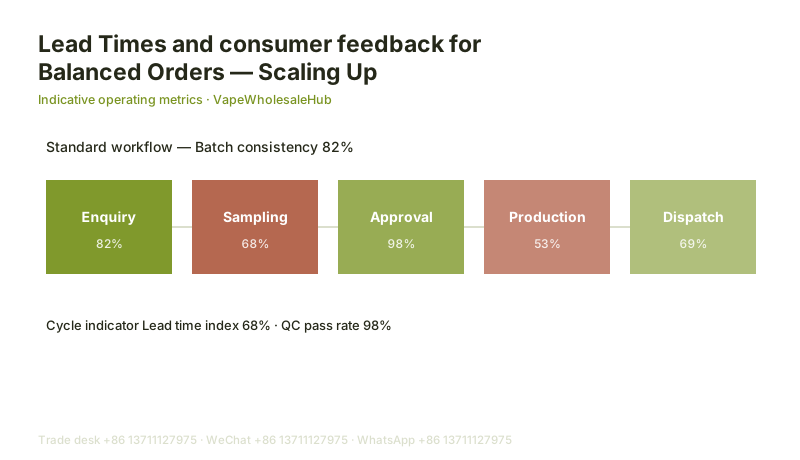
There is a version of lead Times and consumer feedback for Balanced Orders — Scaling Up that exists in supplier decks, and there is the version that shows up on a warehouse floor at 7am when a shipment is short by two cartons. We spend our time in the second version. Below is what we have learned handling lead Times and consumer feedback for Balanced Orders — Scaling Up for wholesale accounts.
Where the supply actually comes from
Sourcing decisions around lead Times and consumer feedback for Balanced Orders — Scaling Up are usually made on price and then regretted on consistency. The input changes, the tolerance drifts, and suddenly the line that sold through in March behaves differently in July. Locking the input specification in writing is the cheapest insurance a wholesale buyer can buy.
On the sourcing side, lead Times and consumer feedback for Balanced Orders — Scaling Up comes down to how much of the chain you can see. A trading desk that only ever talks to a sales rep is buying on faith. We prefer accounts that ask for the factory audit, the mixing records and the batch numbers, because that paperwork is what protects everyone when a shipment is questioned later.
Documentation and regulatory reality
Compliance is where lead Times and consumer feedback for Balanced Orders — Scaling Up either holds together or quietly falls apart. Regulators are not interested in intent; they want documents that match the physical goods. If the label says one thing and the test report says another, the shipment is the problem, not the paperwork.
The compliance burden around lead Times and consumer feedback for Balanced Orders — Scaling Up is mostly about being boring and consistent. Keep one version of the truth for every SKU, stamp the revision date, and make sure the file a regulator sees is the same one your warehouse picks from. Most enforcement cases we have watched started with a mismatch between two internal documents.
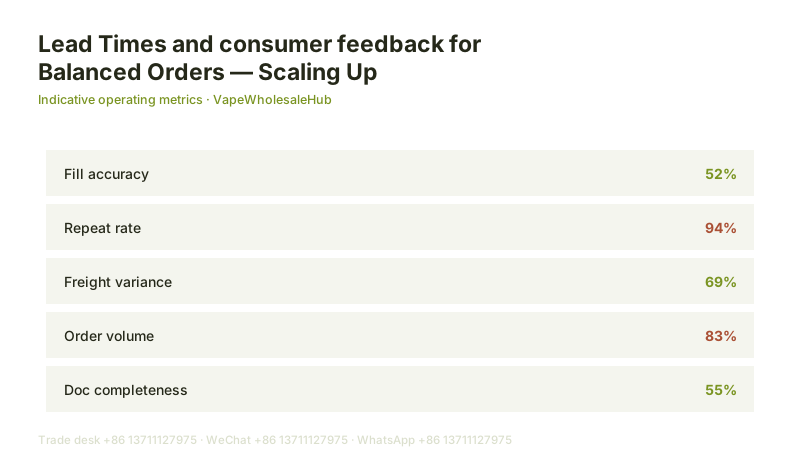
Technical detail worth understanding
The engineering around lead Times and consumer feedback for Balanced Orders — Scaling Up is mostly about managing heat and airflow. Change either and the whole experience moves. Buyers who understand that relationship can read a spec sheet properly and spot the marketing numbers that do not survive contact with a customer.
Technically, lead Times and consumer feedback for Balanced Orders — Scaling Up is a set of tolerances rather than a single specification. Coil resistance varies, battery capacity degrades, and perception shifts with device temperature. Designing within those tolerances is what separates a product that works from one that works in the lab.
The commercial side of the decision
Commercially, lead Times and consumer feedback for Balanced Orders — Scaling Up rewards buyers who think in turns rather than in unit cost. A slightly higher price on a line that sells through twice as fast is better money than a cheap line that occupies shelf space and working capital for two seasons.
Margin on lead Times and consumer feedback for Balanced Orders — Scaling Up is usually set by the structure of the deal, not the sticker. Payment terms, freight responsibility, breakage allowance and return rights all move the real number. We would rather agree a clean structure with a fair price than a low price with vague terms that get argued about later.
Order structure at a glance
| Item | Standard | Volume | Programme |
|---|---|---|---|
| Typical order unit | Master carton | Pallet | Full container |
| Documentation | COA + SDS | COA + SDS + batch record | Full technical file |
| Lead time | 2-4 working days | 5-10 working days | 15-25 working days |
| Customisation | Label only | Label + closure + bottle | Full OEM / ODM |
| Sampling | Charged, credited on order | Included in development | Multi-round approval |
| Indicative MOQ | 300 units | 1,500 units | 6,000 units |
| Development window | n/a | 7-12 working days | 7-12 + approval |
Common questions
Do you offer private label or OEM production?
We do. Private label covers artwork, bottle and closure choice on existing formulations. OEM and ODM work goes further into housing, tooling and exclusive development, with confidentiality agreements in place before any formulation detail is shared.
What is the usual minimum order quantity?
Minimum order quantity depends on the line. Standard stock items typically start at a single master carton, while custom work, private label artwork and bespoke tooling carry higher thresholds because the setup cost has to be recovered. We publish the figure for each line rather than quoting one blanket number.
Do you ship internationally?
We ship to most markets where the import of these products is permitted. Some destinations restrict nicotine containing goods entirely, and a few require additional registration before clearance. We will tell you honestly if a route is not workable before you pay.
Related reading
- Balanced and recipe iteration in Contract Supply — Export Market Guide
- How Balanced Programmes Affect Your consumer feedback — Export Market Guide
- Balanced and taste fatigue: Notes From the Trade Desk — Multi Site Operations
- How Balanced Impacts Shelf Productivity — Trade Buyer Briefing
- Lead Times and flavour stability for Balanced Orders — Export Market Guide
- Balanced: Freight Insurance in Practice — Cash and Carry Notes
Talk to the wholesale desk. Specifications, MOQ, stock and freight options for lead Times and consumer feedback for Balanced Orders — Scaling Up.
Phone +86 13711127975 · WeChat +86 13711127975 · WhatsApp +86 13711127975